Peak Climbing in Nepal: The Ultimate Guide to Your First 6000m Summit
Climbing your first summit above 6000 meters is certainly one of the highlights that will leave you impressed for life. But to ensure I provide as much information as possible, it would be helpful to know how these peaks have been classified.
Mera Peak, Island Peak, and Lobuche East have been classified as "Trekking Peaks" by the Nepal Mountaineering Association (NMA). These make perfect starting peaks for aspiring mountaineers looking to get into high-altitude mountaineering. As for Ama Dablam, it is an expert-level, technical expedition peak controlled by the Department of Tourism. Vertical climbing is key here, and you should only consider climbing the mountain once you have scaled one of the three peaks mentioned before.
In summary, climbing peaks comes next when you have done all you can during treks and now need a challenge. It provides a transition from basic trekking adventures to proper high-altitude mountaineering.
Here is your complete guide to some of Nepal's best beginner and intermediate peaks, categorised by technical difficulty.
Mera Peak climbing (6,470m / 21,227ft)
Detailed Overview
Located in the distant Hinku Valley, Nepal's Mera Peak is the country's highest trekking peak. The unique feature of this peak is that it is not technical. The entire journey includes a very high-altitude glacier hike, which requires excellent fitness but doesn't require prior technical mountaineering knowledge.
Main Attractions
- Unparalleled Summit Panoramic Views: When the sky is clear, five of the fourteen 8000m peaks visible are Everest, Lhotse, Cho Oyu, Makalu, and Kanchenjunga.
- The Trail to Wilderness: Rather than following the regular treks along popular routes, this path leads to the forests and high ridges of the Hinku valley, which are relatively unknown yet stunningly beautiful.
- Experience at High Camp: Stay overnight in the high camp located on a rocky platform next to an enormous glacier, which will make you witness one of the world’s most splendid sunsets.
Itinerary of Short Journey (15 days)
Days 1-5: Flight to Lukla (2,840m); trek from Lukla to Paiya (2,730m).
Days 6-7: Continue the trek to Pangom, Ramailo Danda, and Chatra Khola, then on to Hinku Valley.
Day 8: Trek to Kothe (3,600m).
Days 9-10: Continue the trek to Thang Nak (4,350m) and Khare (5,045m).
Day 11: Acclimatisation and gear training in Khare.
Day 12: Trek from Khare to High camp (5,780m).
Day 13: SUMMIT DAY! Mera Peak (6,470m); descent to Khare.
Day 14: Contingency/weather day.
Days 15-16: Return trek via Zatrwa La Pass to Lukla and flight to Kathmandu.
Island Peak Climbing / Imja Tse (6,160m / 20,210ft)
Comprehensive Overview
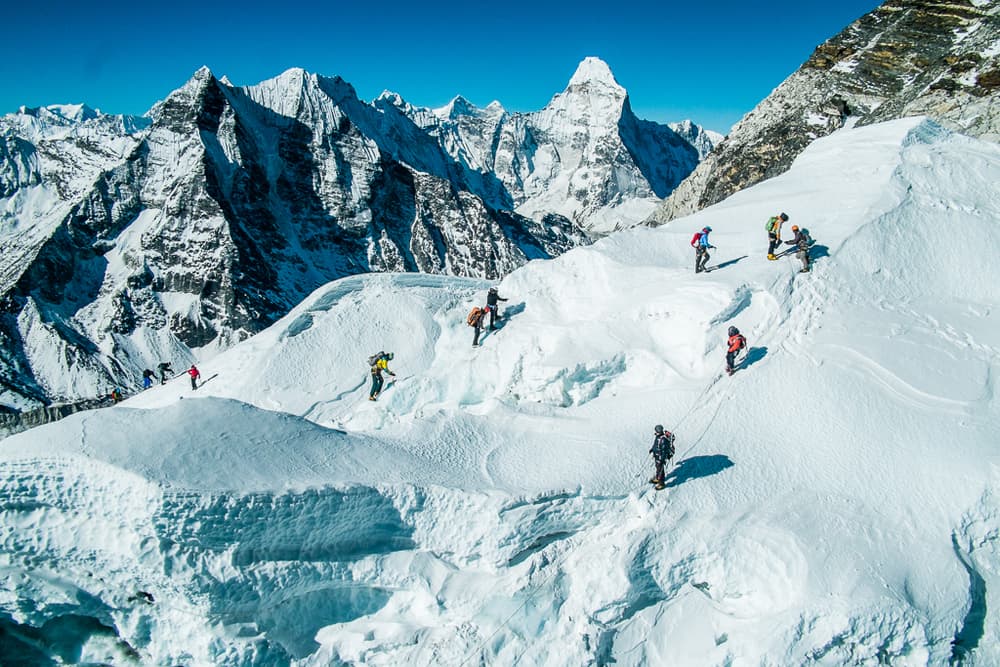
Located in the heart of the Chhukung Valley, much like an island amid an ice desert, Island Peak is the most sought-after mountaineering peak in Nepal. Island Peak is technically challenging. The bottom portion entails a steep scrambling along rock faces, which ends at a working glacier where one needs to cross various cracks using ladders. The critical part is a sheer 100-meter-high ice-and-snow face that you have to ascend on fixed ropes with a jumar.
Top Highlights
- Crux Headwall Challenge: One of the most famous headwalls in the world, providing you with a great chance to showcase your ascending abilities.
- Viewing the South Face of Lhotse: The summit point lies right below the enormous south face of Mount Lhotse.
- Convenient Link with the EBC Circuit: Your journey includes the world-famous route to Everest Base Camp. This will enable you to visit EBC and climb Kala Patthar to properly acclimatise prior to the climb.
Quick Itinerary (15 days)
Days 1-2: Fly to Lukla (2,840m); trek to Namche Bazaar (3,440m).
Day 3: Acclimatisation day in Namche Bazaar.
Days 4-6: Trek via Tengboche and Dingboche (4,410m).
Day 7: Go hiking to either Nagarjun Hill (5,100m) or Chhukhung.
Day 8: Trek to EBC(Everest Base Camp) (5,364m), then backtrack to Gorak Shep (5,140m).
Day 9: Trek to Kala Patthar (5,550m) for sunrise view, then back to Chhukhung.
Day 10: Trek to Island Peak Base Camp (5,200m).
Day 11: SUMMIT DAY: Island Peak (6,160m). Ascend the ice headwall and descend to Chhukhung.
Day 12: Rest/Weather day.
Days 13-15: Descend down to Namche, then Lukla; Fly out to Kathmandu.
Lobuche East Climbing(6,119m / 20,075 ft)
Overview of Lobuche East Climbing
Lobuche East lies directly above the Khumbu Glacier, near the normal trail up to Everest Base Camp. This peak has more technical terrain than the island peak, demanding sure-footed movement on steep slabs of slippery rock (often covered by black ice), crossing a narrow, exposed snow slope, and making a knife-edge traverse along a razor ridge to the top.
Key Highlights
- Alpine Scrambling: Includes some interesting rock scrambling, slab climbing, and steep snow slopes.
- Everest Front Row: Exceptional view overlooking the Khumbu Icefall and Mt Everest, Lhotse and Nuptse.
- Lobuche Fake to True Summit Traverse: An exciting and airy ridge that connects both summits.
Short Itinerary (15 Days)
Days 1-2: Flight to Lukla and trek up to Namche Bazaar (3,440 m).
Day 3: Namche Bazaar acclimatisation.
Days 4-6: Tengboche to Dingboche (4,410m).
Days 7-8: Trek to Lobuche (4,910 m) and climb the acclimatising trail from EBC (5,364m).
Day 9: Trek to Lobuche BC (4,950m).
Day 10: Lobuche high camp (5,400m), establish fixed ropes for training.
Day 11: SUMMIT DAY: Lobuche East (6,119m) and return to Pheriche (4,240m).
Day 12: Weather day / Contingency.
Days 13-15: Namche to Lukla and return flight to Kathmandu.
Ama Dablam Expedition (6,812m / 22,349 ft)
Detailed Overview
Ama Dablam is considered one of the most visually stunning and technically challenging mountains in the world. This is a truly elite mountain requiring high-end technical climbing on steep granite walls, mixed rock/ice sections, and extremely steep ice faces. Multiple high camps are required, technical rappelling from great drops, and climbs of features such as "The Yellow Tower" (Grade 5.7 / French IV) and "The Grey Tower." Previous high altitude climbing experience at 6,000m is a necessity.
Key Features
- Luxury Alpinism: Satisfies the alpine adventure of technical multi-pitch rock and ice climbing at extreme altitude.
- The Yellow Tower: Famous granite rock face climb at 6,000 meters using jumars and climbing with an expedition pack.
- Luxury Advanced Camp Rotations: Includes a luxury expedition experience with nights spent on tiny, cliff-side tent platforms at Camp 2 at 5,900 meters.
Short Itinerary (22 days)
Days 1-5: Flight to Lukla, trek to Namche Bazaar and Khumjung, and first round of acclimatisation.
Days 6-7: Trek to Ama Dablam Base Camp at 4,570 meters.
Days 8-10: Puja Ceremony at Base Camp, gear sorting, acclimatisation trek to Yak Camp at 5,180 meters.
Days 11-15: Acclimatisation rotations with ascents to Camp 1 at 5,700 meters and touching Camp 2 at 5,900 m.
Days 16-19: SUMMIT WINDOW: Base Camp → Camp 1 → Camp 2 → SUMMIT 6,812m through steep ice mushrooms and descending safely to Base Camp.
Days 20-22: Packing and descending from base camp to Namche and Lukla to fly to Kathmandu.
Equipment Checklist
You can carry the same baseline equipment for Mera, Island, and Lobuche. If you decide to go for Ama Dablam, you only have to add some technical climbing gear – rock shoes, multiple ascenders, and a technical harness.
Technical Climbing Equipment
- Mountaineering Boots: Insulated double boots with removable lining (La Sportiva G2 SM or Scarpa Phantom 6000); soft-leather trekking boots may lead to frostbite on a glacier.
- Crampons: Automatic or semi-automatic 12-point steel crampons.
- Harness and Helmet: Lightweight adjustable alpine harness and standard UIAA-approved mountaineering helmet.
- Mechanical Ascender (Jumar): Right or left-hand-operated Jumar handle to climb fixed ropes.
- Belay/Rappelling System: ATC Guide or Figure-8 device to descend from fixed ropes.
- Ice Axe: Straight-shaft mountaineering axe; technical gear (ice tool + helmet mount) for Ama Dablam.
- Carabiners: 2 locking and 2 non-locking carabiners, plus a dynamic safety tether.
Technical High Altitude Clothes and Sleeping System
- Summit Down Jacket: Down jacket of 800 fill and insulated down pants.
- Gloves: Thin liner, thick mountaineering gloves, and protective over-mittens.
- Sleeping Bag: Down sleeping bag rated for -20 °C to -30 °C for tented high-altitude camps.
Vital Climbing Permits and Regulations
No independent climbs allowed! It is illegal to climb any of these peaks on your own! According to Nepalese law, you must register with a registered agency and pay for the mandatory permit for the expedition, logistics, and a climbing Sherpa.
Trekking Peaks (Mera, Island, Lobuche): Permits are priced by season; fees follow a strict schedule.
Season 1 (Spring): $350 USD/person
Season 2 (Autumn): $175 USD/person
Season 3: $175 USD/person
In addition to paying for the permit, each expedition pays a mandatory $500 USD deposit toward garbage fees per team.
Expedition Peaks: Permits are regulated directly by Nepal's Department of Tourism.
Ama Dablam: Approximately $400 USD per climber in Autumn, $1,000 USD in Spring, and a mandatory garbage deposit of $3,000 USD per expedition.
Trekking Permits: All peaks in the Khumbu region require a permit issued by the Khumbu Local Municipality (3,000 NPR) and the Sagarmatha National Park (3,000 NPR). Mera Peak requires a permit issued by Makalu Barun National Park instead of Sagarmatha National Park (3,000 NPR).
Frequently Asked Questions (FAQ)
Between Mera and Island, which one should I take as a novice climber to conquer my first 6,000 meters?
If you want to test your endurance against high altitudes and sheer climbing distance, choose Mera Peak. For a thrilling experience that gives you a chance to work with ladders and vertical rope walls, select Island Peak.
Can I hire climbing equipment along the trail?
Yes! No need to bring expensive mountaineering boots, crampons, or a harness! High-quality equipment rentals are available at the last trailheads (Chhukung for Island; Khare for Mera) for about $100- $150 USD.
I haven't learned the basics about using ropes yet! Will I still make it up?
Don't worry! On your acclimatisation days, the experienced Sherpas organise a mandatory rope clinic in Base Camp. They set up a mock rope course at a nearby rock or ice wall and teach you to lock the jumar, switch positions at anchors, and rappel safely.
Can I do Ama Dablam right after the first trekking peak?
Technically, yes, but highly discouraged! Ama Dablam features intense vertical exposure where you must control the rope yourself over a 1,000-foot drop-off. Climbers with prior experience on trekking peaks like Lobuche and Island Peak can perform better.